Overview
A full-stack Reversi (Othello) project built from scratch—from a high-performance Rust game engine to a web app and AlphaZero-style AI training pipeline. The game engine uses bitboard representation for fast move generation and search. It is published as both a Rust crate and a Python package, and powers the web application and various AI experiments. As of February 14, 2026, ranked 24th on the CodinGame Othello leaderboard.
Live Demo: Play Reversi in your browser
Architecture
The project is organized into six repositories, layered by responsibility:
| Layer | Repository | Description |
|---|---|---|
| Game Engine | rust_reversi_core | Bitboard engine, alpha-beta search, arena system. [crates.io] |
| Python Bindings | rust_reversi | PyO3/maturin bindings exposing board, search, and arena to Python. [PyPI] |
| Backend | reversi-backend | FastAPI REST API with game session management, AI opponents, and PostgreSQL stats. |
| Frontend | reversi-frontend | React 19 + TypeScript + Tailwind CSS v4 web UI. |
| AI Experiments | reversi_ai | Genetic algorithms, supervised learning, RL, and knowledge distillation. |
| AlphaZero | reversi-zero | Self-play MCTS in Rust + PyTorch training loop. |
Game Engine
The core engine is written in Rust with a focus on performance:
- Bitboard representation: The entire 8×8 board state fits in two
u64values, enabling fast bitwise move generation and flipping. - Alpha-beta search: Iterative deepening with timeout control and pluggable evaluation functions (piece count, positional matrix, custom).
- MCTS: Monte Carlo Tree Search with UCB1 for playout-based decision making.
- Arena: Local and TCP/IP network match systems with automatic statistics collection.
Web Application
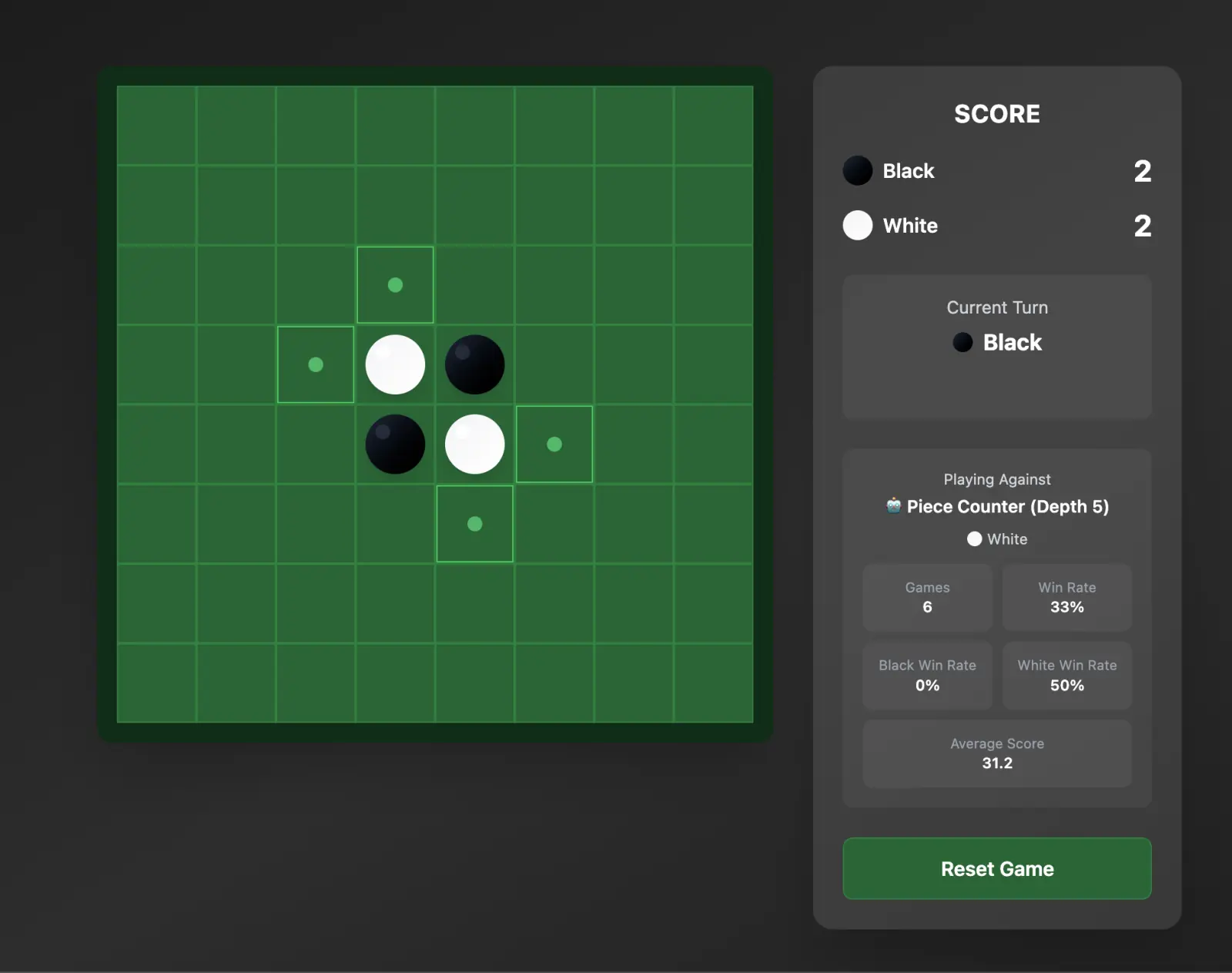
A full-stack web app for playing Reversi against AI opponents in the browser.
- Frontend: React 19, TypeScript, Vite, Tailwind CSS v4. Responsive design with legal move indicators and real-time score tracking.
- Backend: FastAPI serving a REST API. Manages game sessions in memory, spawns AI player processes, and records AI statistics (win rate, average score) in PostgreSQL.
- AI opponents: Random, alpha-beta with piece evaluation (depth 3 and 5). Extensible to custom players.
- Deployment: Dockerized frontend and backend, running on my homelab via Cloudflare Tunnel.
AI & Training
Multiple approaches to building stronger Reversi players:
- Genetic algorithms: Evolving evaluation function weights, implemented in both Python and Rust.
- Supervised learning: Training neural networks on game records.
- Reinforcement learning: Policy optimization through self-play.
- Knowledge distillation: Compressing strong models into smaller, faster ones.
- AlphaZero pipeline (reversi-zero): Rust handles parallel self-play with batched MCTS inference, Python/PyTorch trains policy+value networks, and TorchScript bridges the two. Each iteration generates games, trains the network, and evaluates against baseline opponents.
Tech Stack
- Game Engine: Rust, bitboard, alpha-beta, MCTS
- Python Bindings: PyO3, maturin
- Frontend: React 19, TypeScript, Vite, Tailwind CSS v4
- Backend: FastAPI, PostgreSQL, SQLAlchemy, Alembic
- AI/ML: PyTorch, TorchScript, NumPy
- Infrastructure: Docker, GitHub Actions, Cloudflare Tunnel